


 Home
HomeThe Ultimate Guide to Recessed LED Strip Lighting Channels: How to Achieve Spotless Surface Luminescence and Modern Architectural Aesthetics
 May 29,2026

 reddy
reddy
In modern architecture, light has evolved from a basic necessity into a vital design language that sculpts spatial structures, shapes atmospheres, and redefines visual dimensions. As a core component in achieving this leap, recessed LED strip lighting channels (also known as recessed linear profiles) possess the unique ability to transform raw, pixelated point light sources into a seamless, continuous ribbon of light that perfectly integrates into walls, ceilings, or high-end millwork. This comprehensive guide breaks down the ultimate implementation logic of recessed LED aluminum channels across multiple dimensions, including thermodynamics, optical diffusion control, architectural applications, and master-level on-site installation.
The Core Value and Structural Technology of LED Aluminum Channels
A recessed LED aluminum channel is an architectural housing component engineered for concealed, flush-mount strip light installations, typically consisting of a 6063-T5 high-purity anodized aluminum extrusion body, a high-diffusion polycarbonate (PC) or PMMA cover lens, end caps, and mounting clips. Seasoned lighting designers and senior electrical engineers never adhere bare LED strips directly onto wood, plasterboard, or other structural substrates because the integration of premium aluminum channels is backed by three critical technical pillars.
First, it serves as the ultimate thermal sink; highly conductive anodized aluminum acts as an exceptional passive heat sink, rapidly dissipating the microscopic junction temperature generated by high-performance LED strips under load, which can extend the operational life of an LED strip by up to 50%. Second, it eradicates "visual spots" and harsh, pixelated glare through calculated coordination of the channel's depth and the lens's diffusion coefficient, enabling flawless linear color-mixing and erasing dark zones. Third, the channel forms a rigid, protective barrier for vulnerable flexible printed circuit boards (PCBs) against dust, ambient moisture, and accidental everyday impacts, significantly reducing long-term maintenance and costly rework. Studies indicate that LED strips housed within premium aluminum channels maintain an incomparably higher lumen maintenance rate (L70) after 50,000 hours of continuous operation compared to those adhered directly to raw plastic or wood surfaces, where high thermal retention can accelerate lumen decay by over 30%.
Structural Classifications and Architectural Design Integration
Depending on the trim aesthetics and the specific stage of interior construction, recessed aluminum profiles are broadly divided into two primary design families, each aligning with distinct dry-lining or millwork workflows. Flanged (or trimmed) profiles feature a narrow, overlapping outer lip (typically 2mm to 5mm) that elegantly masks minor edge chipping, rough saw cuts, or structural tolerance gaps caused during the routing of drywall, wood paneling, or stone. This design is ideal for custom cabinetry integration (such as wardrobes, bookcases, and under-cabinet vanity lighting), post-construction drywall retrofits, and any intersection where contrasting materials meet, offering high fault tolerance and making it the most efficient choice for high-end millwork and commercial retail displays.
Conversely, trimless (or mud-in/plaster-in) profiles represent the pinnacle of minimalist and modern architectural aesthetics, featuring wider, perforated wing extensions on both sides. During installation, the profile is fastened directly to the drywall studs or ceiling framing using self-tapping countersunk screws, allowing contractors to apply multiple layers of joint compound (mud) directly over the perforated wings, followed by sanding and painting. This method is uniquely suited for luxury residential estates, art galleries, and upscale corporate headquarters; when turned off, the profile completely disappears into the wall or ceiling, leaving nothing but a smooth, monolithic plaster surface, but when illuminated, it looks as if the very structure of the building has cracked open to omit a pure, ethereal line of light.
The Optical Equation: Profile Depth and Lens Selection for Spotless Diffusion
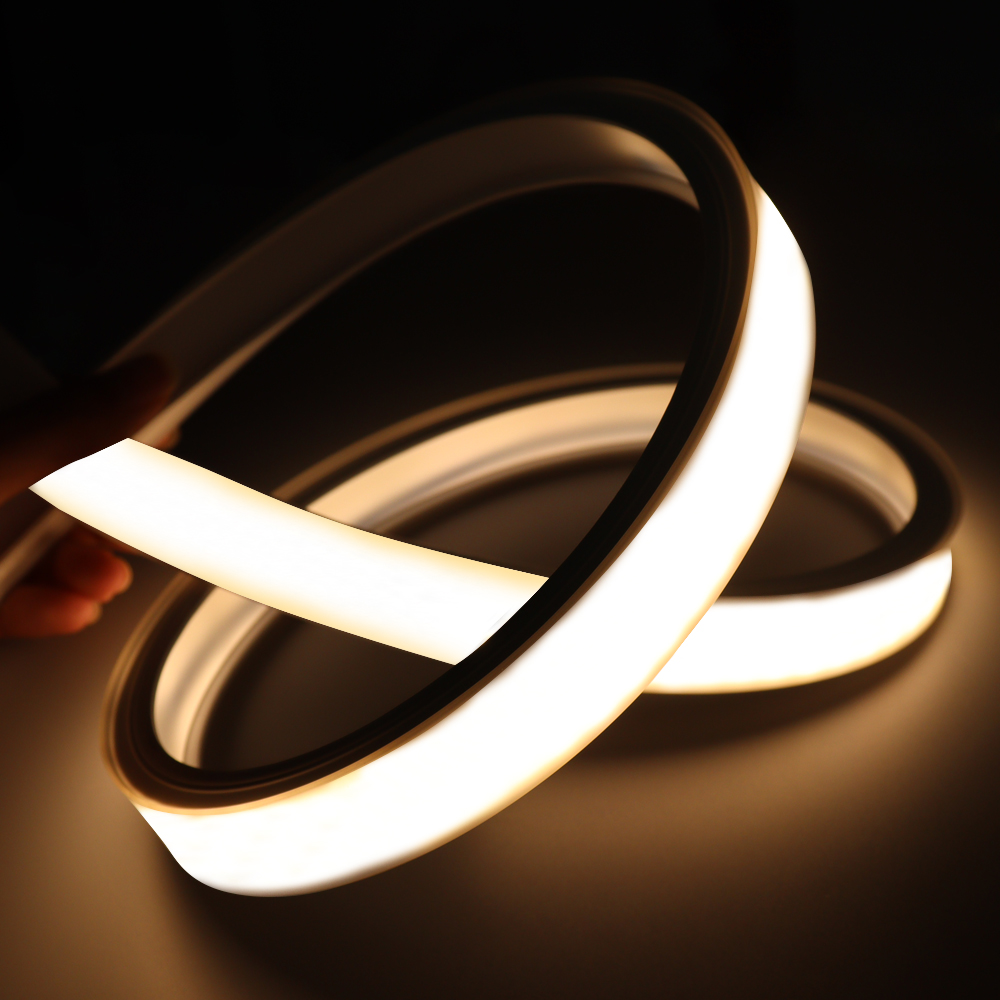
Achieving a truly flawless, continuous line of light requires a calculated synergy between profile depth, LED diode density, and diffuser lens properties. Low-profile channels (depth: 6mm–9mm) have an extremely restricted space between the LEDs and the lens, making light mixing highly challenging; standard LED strips will inevitably produce visible hot spots, meaning these shallow profiles must be paired with ultra-high-density COB (Chip-on-Board) LED strips to create a continuous luminous surface for ultra-narrow baseboards or indirect toe-kick lighting. Standard-profile channels (depth: 12mm–15mm) strike an ideal compromise between light output efficiency and soft diffusion, performing exceptionally well for task lighting inside closets or decorative accent geometry on feature walls when paired with high-density SMD strips containing 120 or more LEDs per meter. Deep-profile channels (depth: 18mm–25+mm) provide ample physical distance for the light waves to cross-mix and diffuse before reaching the lens cover, guaranteeing absolute, dot-free uniformity even when using standard-density SMD strips, making them the industry standard for main architectural ambient lighting on ceilings where the light source is in direct line of sight.
The choice of diffuser cover introduces another critical optical variable. Opal or milky diffusers reduce total light output by approximately 20% to 30%, but they deliver a diffusion rate exceeding 95%, making them the absolute standard for premium architectural spaces where glare-free, continuous illumination is required. Semi-clear or prismatic diffusers minimize light loss to roughly 10% to maximize lumen output, though individual diodes remain partially visible, making them ideal for indirect lighting coves where the channel is hidden from the eye. Finally, black diffusers represent the hallmark of high-end dark luxury styling; when turned off, the lens presents a stark, matte-black line that blends seamlessly into dark wood veneers, charcoal wall treatments, or raw architectural concrete, and when illuminated, it emits a subtle, moody ambient glow, creating a dramatic visual effect at the cost of significant lumen reduction.
Master-Level Installation Standards and Pitfall Prevention
The ultimate execution of linear lighting hinges entirely on the precision of the installation process, which is why Reddy Lighting's elite project implementation teams strongly advise banning heavy-duty hand shears or wire cutters on site. Many field installers resort to these tools to quickly cut aluminum profiles, which severely crushes and deforms the channel endpoints, cracks the finish, and prevents the PC diffuser and end caps from snapping into place securely. Installers must instead use a motorized miter saw fitted with a high-tooth-count non-ferrous metal blade to achieve perfectly clean, burr-free 45 or 90-degree cuts.
The standard engineering sequence begins with precise verification and routing, ensuring the substrate has adequate depth and is clear of structural framing or electrical conduits before routing or cutting the channel slot with a minute installation tolerance of +0.5mm. Next, wire entry holes must be pre-drilled at the back or ends of the profile, ensuring all metal burrs are completely filed down, and the interior of the channel must be thoroughly wiped down using isopropyl alcohol to remove any residual factory cutting oils or dust, which is paramount to ensuring the 3M adhesive backing of the LED strip bonds permanently without peeling over time. During LED adhesion, the strip must be cut along designated cut lines and firmly pressed into the channel; if multiple lengths of aluminum channels are being joined sequentially, installers must stagger the LED strip joints at least 100mm away from the aluminum profile seams to effectively eliminate any micro-leakage of light through the physical gaps. Finally, the end caps are affixed, the PC diffuser lens is fed or snapped into the aluminum profile using a progressive press-fit motion, and the entire linear fixture is mounted into the routed cavity, securing it firmly using heavy-duty construction adhesive or hidden internal tension clips.
Architectural Mastery through the Reddy Linear Solution
Recessed LED strip lighting channels do far more than simply hide a light source; they return lighting to its purest form—where the light is felt, but the fixture is unseen. Simultaneously, they construct the structural, thermal, and optical foundation necessary for a long-lasting, safe, and glare-free LED ecosystem. Whether designing a minimalist private estate or configuring the public circulation zones of a massive commercial complex, selecting the appropriate profile, calculating correct depths, and executing exact installation standards marks the boundary between mediocre lighting and architectural mastery.
As a relentless global innovator in linear lighting systems, Reddy Lighting supplies a comprehensive portfolio of bespoke solutions, spanning from micro-cabinet profiles to massive plaster-in drywall channels and exterior-grade waterproof linear systems. We recognize that every millimeter of a profile's cross-section dictates the ultimate quality of the light cast in your space, and we stand ready to bring elite engineering and unparalleled luminous texture to your next landmark design.
 Recessed LED Extrusions: Mastering Profile Depth & Installation for Zero Hot Spots
  About us
 SANAG BLOG
 faq
faq Contact us