


 Home
HomeRecessed LED Extrusions: Mastering Profile Depth & Installation for Zero Hot Spots
 May 29,2026

 reddy
reddy
The Physics of Seamless Illumination: Solving the Hot Spot Dilemma
In high-end architectural design, the magic of light lies entirely in its distribution. When walking through a luxury hotel lobby, an elite residential corridor, or a minimalist spa-like shower, your eyes should never be drawn to the raw physical source of illumination. Instead, you are meant to experience the space as a multi-dimensional canvas where planes of light natively emerge from the walls, ceilings, and structural recesses. For decades, traditional light fixtures broken by visible bulbs, unappealing bezels, and uneven throw angles disrupted this continuity.
The widespread adoption of linear LED strip lighting promised a revolution in visual purity, but it introduced a notorious technical frustration known across the industry as the hot spot dilemma. Hot spots are those harsh, pixelated, or dotted reflections where individual light-emitting diodes (LEDs) project as sharp points of light rather than a single, perfectly continuous, cloud-like beam. This aesthetic imperfection instantly betrays the luxury illusion, transforming a high-end millwork piece or wall cutout into an amateur installation.
Eliminating these visual interruptions requires a fundamental understanding of architectural physics, material science, and spatial engineering. At the very heart of this solution is the precise orchestration of profile depth, diode density, and diffusion mechanics. When selecting and installing recessed LED extrusions—commonly referred to as linear aluminum channels—designers and specifiers are not merely choosing a metal housing; they are engineering an internal optical chamber where raw, high-intensity light points are systematically softened, blended, and homogenized before they ever reach the human eye.
Mastering the Mechanics of Profile Depth and Diffusion
The journey toward achieving a flawless, dotless glow begins inside the internal geometry of the aluminum extrusion itself. The single most critical variable determining whether a linear lighting installation will display hot spots or a continuous beam is the physical distance between the face of the LED diode and the bottom surface of the frosted diffuser lens. This specific dimension is known as the profile depth or internal clearance height.
To visualize how this works, consider the behavior of light as it leaves a standard surface-mounted diode. LEDs do not project light in a completely flat sheet; they emit it in a cone-like path, typically spreading outward at a beam angle of roughly 120 degrees. When an LED strip is placed inside an ultra-shallow extrusion channel, the expanding cones of light from adjacent diodes strike the diffuser lens almost instantly. Because the light has not had enough physical space to spread horizontally and overlap with the light from neighboring pixels, the individual bright centers of each diode remain starkly visible through the cover, resulting in distinct dots.
By choosing a deeper architectural profile, you give these expanding 120-degree light cones the vertical distance they require to branch outward, intercept one another, and completely blend inside the channel. By the time this integrated light front meets the high-molecular-weight Polycarbonate or PMMA diffuser lens, the independent boundaries of each diode have been structurally erased. The diffuser cover then acts as a final homogenizing filter,scattering the unified light wave evenly across its surface.
This spatial dynamic means that profile selection can never be an afterthought. For example, if your design requires a razor-thin, shallow profile due to strict physical limitations in thin furniture panels or drywall substrates, you must actively compensate for the lack of internal depth by selecting a linear LED strip with a significantly higher diode density—such as ultra-dense arrays or Chip-on-Board (COB) strips—where the physical gaps between diodes are virtually nonexistent. Conversely, when deep, heavy-duty architectural channels are utilized, the generous internal clearance provides an automatic buffer, allowing even standard-density diode strips to achieve a smooth, premium, pixel-free output.
The Pre-Engineered Answer: Integrated LED Wall Niches
While calculating profile depths and custom-building lighting channels works beautifully for custom millwork and dry interior walls, executing this flawless look in wet or high-traffic structural environments introduces immense installation vulnerabilities. In locations like luxury walk-in showers, steam rooms, bathroom vanities, or prominent hallway focal points, custom-building a recessed light channel behind stone or tile often requires a complex web of mitered tile cuts, delicate waterproof membranes, and highly specialized on-site coordination between framing, tiling, and electrical trades. One minor error in alignment or a microscopic failure in waterproofing, and the entire installation risks leaking, cracking, or showing uneven light distribution.
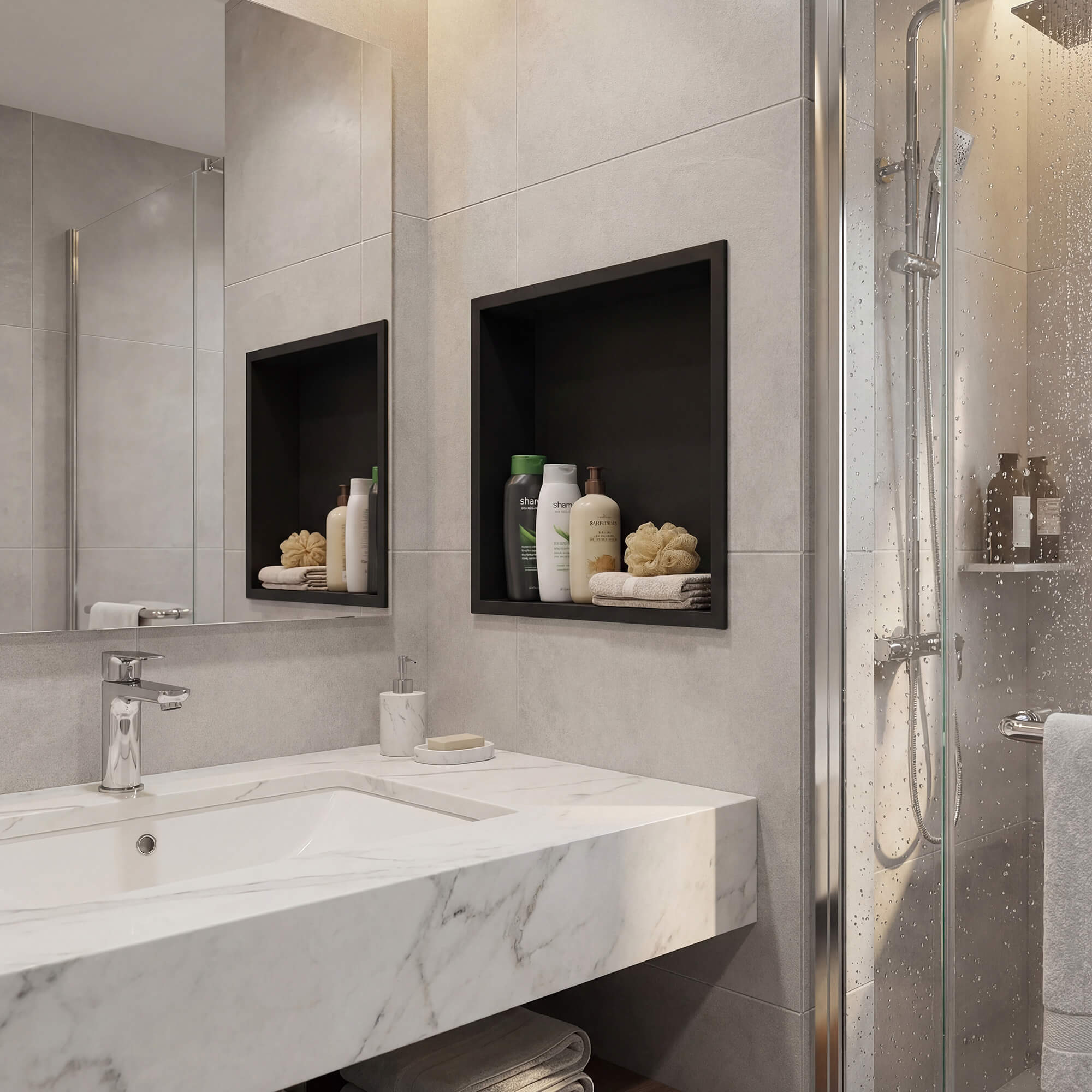
To eliminate these complex labor bottlenecks and guarantee an absolutely perfect, hot-spot-free architectural result, forward-thinking designers are turning to pre-engineered, fully integrated structural units. A prime example of this industrial innovation is the Golden Recessed LED Wall Niche (Model: RD-NC30530580-G) manufactured by Reddy Lighting. This fixture represents the ultimate intersection of minimalist storage, premium material science, and masterfully balanced accent lighting, engineered specifically to sit entirely flush with finished wall surfaces without stealing valuable floor footprint.
Measuring a versatile 305×305×80mm (approximately 12x12x3 inches), this structural niche is crafted from industrial-grade stainless steel rather than lightweight plastics or vulnerable custom tile backers. This heavy-duty metal composition provides the rigorous structural stability required to resist warping or bowing under the immense weight of heavy stone tile or natural wall settling over time. The standout aesthetic element is its premium brushed gold finish, achieved through advanced physical vapor deposition (PVD) or specialized mechanical brushing techniques. Rather than a superficial topical paint layer or a cheap spray lacquer that would easily bubble, peel, or flake when exposed to hot steam and humidity, the PVD process binds the rich, desaturated champagne-gold tone directly into the stainless steel matrix at a molecular level. The resulting fine brushed texture elegantly resists fingerprints, hard water scaling, and chemical corrosion from upscale soaps and shampoos.
What makes this integrated system completely transformative from an optical perspective is how it completely bypasses the traditional hot spot dilemma. Reddy Lighting has pre-calibrated the entire internal light path. Tucked discretely within a hidden overhead light channel inside the top flange of the niche is a factory-sealed, low-glare, high-density LED light source protected by a custom-engineered frosted lens. The internal depth of the hidden casing ensures that the light is entirely diffused before it escapes.
Furthermore, the brushed gold background of the inner compartment acts as a secondary, soft, organic reflector. When the hidden, uniform LED light casts downward onto the gold metal, the brushed texture scatters the light waves even further while warming the color temperature slightly. This creates an incredibly welcoming, candle-like ambient glow that radiates outward across the surrounding tile or plasterwork. It completely eliminates harsh down-shadows, transforms ordinary toiletries into high-end structural displays, and tricks the human brain into perceiving the wall as multi-dimensional, making small bathrooms or narrow hallways feel significantly wider and deeply relaxing.
Advanced Installation Strategy and Structural Planning
Achieving the seamless visual purity of a flush-mount, hot-spot-free linear lighting installation requires meticulous physical and electrical planning during the raw construction phases. Whether you are embedding individual linear aluminum channels into a drywall ceiling or dropping a pre-engineered Reddy Lighting stainless steel niche into a luxury shower wall, the execution must be flawless to maintain long-term material integrity and clean lines.
The first phase centers on precision structural framing. For recessed systems, a dedicated structural pocket or continuous horizontal wood blocking must be built directly between the wall studs during the initial rough-in. In the case of the 305×305mm Reddy niche, installers create a structural box that precisely cradles the exterior casing of the unit, leaving just two to three millimeters of breathing room for micro-adjustments.
The second phase involves strict electrical infrastructure planning. Because these luxury fixtures utilize safe, low-voltage 24V DC architectures to ensure absolute safety in wet environments and prevent voltage drop across extended runs, a remote LED driver or transformer must be utilized. A critical rule of high-end lighting design is that transformers must never be permanently buried behind finished drywall or sealed tiling. Instead, low-voltage supply wires are run from the structural framing box back to an accessible, well-ventilated utility location, such as a vanity cabinet, a nearby linen closet, or a dedicated home automation panel. This ensures that if a driver requires maintenance or upgrading after decades of operation, it can be serviced instantly without tearing into the luxury finishes of the space.
The third phase addresses waterproofing and final integration, which is paramount in wet zones like walk-in showers. Once the cement backer board or specialized waterproof foam panels are anchored around the framing cutout, a continuous liquid or fabric waterproofing membrane must be applied meticulously right up to the crisp edge of the opening. The integrated LED wiring pigtails from the niche are then spliced into the low-voltage supply line using heavy-duty, IP67-rated waterproof wire connectors.
Before applying any structural adhesives, a dry-fit phase must be conducted to ensure the front perimeter flanges of the niche sit completely flush and level with the intended thickness of the coming tile or stone. Finally, premium polyurethane construction adhesive or specialized thin-set mortar is applied generously to the rear and side flanges of the steel unit. The niche is slid firmly into the structural box, pressed level, and allowed to cure. Once the surrounding tile work is complete, a clean, narrow bead of color-matched, anti-fungal silicone caulk is applied around the metal perimeter seam, sealing the entire assembly against vapor transmission and creating a permanent, watertight, and drop-dead gorgeous architectural anchor.
Design Aesthetics and Sophisticated Material Pairings
The architectural power of a perfectly diffused, golden recessed light niche is its astonishing versatility across modern design languages. Far from looking gaudy or overwhelming, a desaturated, champagne-tinted architectural gold functions as a powerful balancing element that can anchor or elevate several prominent interior design palettes.
In dark, moody, or deeply textured modern environments—such as a contemporary shower wrapped in matte black porcelain slabs, dark charcoal concrete plaster, or deep forest green handmade zellige tiles—the illuminated golden niche creates an breathtaking, high-contrast focal point. When the hidden LED system is turned on, the niche glows softly like a treasure chest embedded in dark stone, instantly breaking up the visual weight of dark walls and turning a utilitarian bathroom into an elite, spa-like sanctuary.
For projects that lean toward warm organic modernism—characterized by soft creams, fluted white oak vanities, and natural travertine stone surfaces—the golden niche serves as a harmonious, complementary accent. It bridges the gap between raw, tactile earth tones and crisp, high-tech linear illumination. By mirroring the tones of brushed brass or champagne bronze plumbing fixtures and cabinetry hardware, it weaves a thread of continuity throughout the room, making the lighting feel entirely native to the home's architecture.
Even in ultra-classic, bright minimalist luxury layouts that leverage expansive white or soft grey marbles like Calacatta or Carrara, a series of these golden square niches provides an invaluable pop of visual warmth. It cuts through the inherent coldness of white stone surfaces, preventing the space from feeling clinical and giving the eye a polished, deeply intentional design anchor that celebrates the interplay of pure light and industrial metal.
Long-Term Maintenance and Architectural Value
Selecting a factory-sealed, industrial-grade stainless steel recessed niche over traditional custom tiled shelving does more than just elevate the visual output of your lighting design—it completely redefines the long-term maintenance lifecycle of the home. Custom-tiled shower niches with standard grout lines are notorious magnets for pink mold, soap scum build-up, hard water scaling, and eventual membrane failure. The seamless, precision-welded metal construction of the Reddy niche removes these maintenance headaches entirely.
Because the interior surfaces are entirely smooth and non-porous, keeping the fixture pristine requires minimal effort. Weekly upkeep simply involves wiping the interior down with a soft, clean microfiber cloth dipped in warm water and a single drop of mild, pH-neutral dish soap to break up any residual body oils or shampoo films. To preserve the PVD brushed gold finish for generations, users must avoid harsh industrial chemicals like bleach, hydrochloric acid, or abrasive steel wool scrubbing pads, which can create microscopic surface scratches and dull the elegant, soft metallic luster.
Ultimately, integrating a masterfully diffused, recessed LED extrusion or a pre-engineered illuminated wall niche into an upcoming architectural project is a commitment to timeless design engineering. By prioritizing profile depth, hidden light paths, and premium material finishes over cheap, superficial fixes, you eliminate the visual clutter of hot spots and protruding fixtures. The result is a space that feels balanced, upscale, and profoundly permanent—a true testament to the art of luxury hidden in the details.
 The Ultimate Guide to Recessed LED Strip Lighting Channels: How to Achieve Spotless Surface Luminescence and Modern Architectural Aesthetics
  About us
 SANAG BLOG
 faq
faq Contact us